
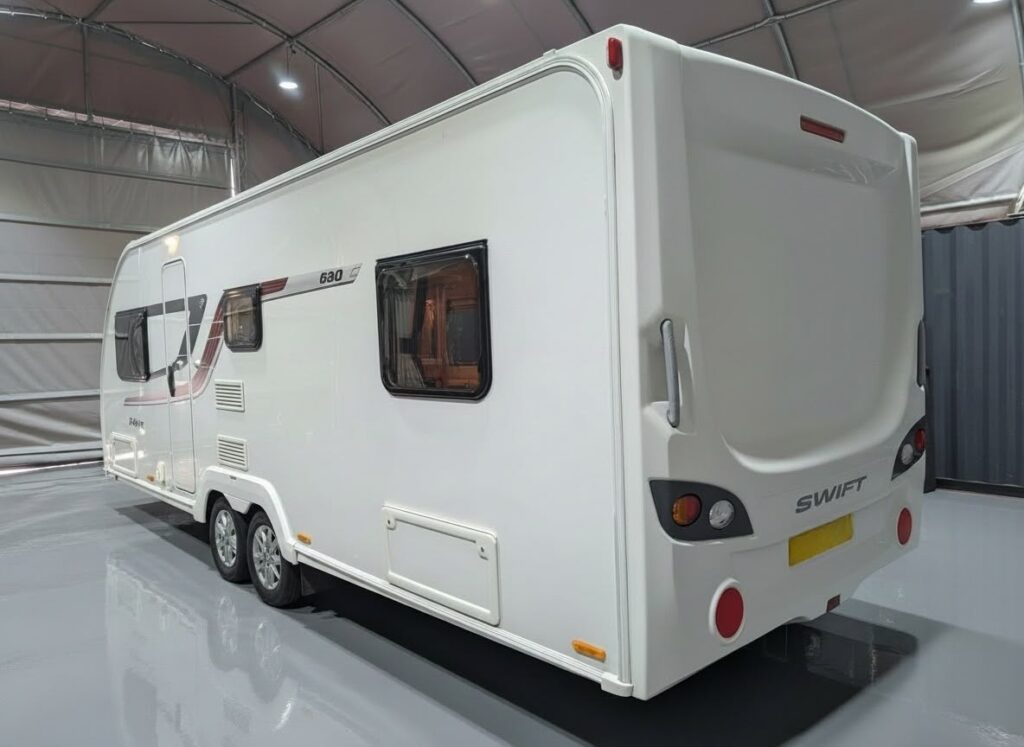
What a damp reading means for a damp caravan’s value
Damp is measured with a meter pressed against the wall, and it gives a percentage. That number is the whole conversation, so it helps to know what the bands mean.
- Under 15%. Generally acceptable. Most caravans over five years old will show something somewhere, and readings in this range usually cost you nothing.
- 15% to 20%. Worth watching. Often a seal that has aged rather than a structural problem, but it needs finding.
- 20% and above. Active water ingress. Something is letting water in and it has been doing so for a while.
- A soft or spongy floor. The one that matters most. Press the floor at the shower tray and just inside the door — give underfoot means long-term ingress that has reached the structure.
Readings vary across a caravan. A proper check covers every window surround, the front locker seams, the wardrobe base and the washroom corners, at height and at floor level. Water travels downwards, so a high reading low down can have its source a long way up.
Not sure where your caravan stands? Get a free caravan valuation — we will take the readings, show them to you, and tell you what they mean for your figure. No obligation.
What caravan damp repair costs
There is no single answer, because the cost depends entirely on how far the water has travelled before anyone found it. But real figures are published, and they are worth knowing before anyone quotes you.
| What | Reported cost | Source |
|---|---|---|
| Damp repair labour | £50–£75 per hour | Checkatrade cost guide |
| Full damp report with habitation inspection, single-axle caravan | £275 | Damp Repair Centre published price list |
| Same, twin-axle caravan | £355 | Damp Repair Centre published price list |
| Same, motorhome | £235 | Damp Repair Centre published price list |
| Repairing one affected corner | Around £800–£1,000 | Estimated by an experienced owner on the Practical Caravan forum |
| A caravan needing significant work | £2,000 and upwards | A 2010 Swift Challenger owner on the Caravan Club forum, quoted by two separate specialists |
These are other people’s figures and they are quoted as such. We have not adjusted them and we do not claim them as ours.
The pattern behind them is consistent, and every workshop says the same thing: catching it early is the difference between a reseal and a rebuild. A caravan is a timber frame clad in aluminium and lined with ply. Once water reaches the frame, the repair stops being about sealant and starts being about structure — stripping the panel, replacing rotten timber, and rebonding.
That is also why damp quotes vary so much between workshops. The visible patch is rarely the extent of it, and an honest estimator allows for what they will find once the panel is off.
How much damp reduces a damp caravan’s value
Damp caravan value works on one principle: the deduction should track the repair cost, not the fear.
A caravan with a small area of elevated readings in one corner is not the same proposition as one with a soft floor and multiple affected areas. Any buyer treating them the same is not really valuing your caravan.
Work it through with a real example. Take a 2015 four-berth retailing at around £10,995 on our forecourt. If it needs a corner repaired at somewhere near £900, that money has to come out of the figure before anyone can sell it on. It does not make the caravan worthless. It makes it a caravan with a £900 job attached.
What should never happen is a deduction quoted before anyone has looked. A figure is only meaningful once a meter has been round the caravan and you have seen the readings.
Should you repair damp before selling?
Usually not, and the arithmetic is worth doing before you commit to a workshop.
The case against repairing. A repair costs you the full retail price of the work. The deduction it removes is usually less than that, because a trade buyer repairs it at trade cost. Spend £2,000 to remove a deduction of less than £2,000 and you have paid for the privilege of selling.
When repairing does make sense. If the damp is small, caught early, and the fix is a reseal rather than a panel. A few hundred pounds on a caravan you plan to use for another two or three seasons is money well spent. Then you are buying use, not resale value.
One thing that never pays. Patching over it. A damp meter finds water in minutes, and a caravan presented as dry that is not costs you far more in credibility than the reading ever would have.
The owner quoted £2,000 on a sixteen-year-old caravan is the clearest example of the trap. Against what that van is worth, the repair swallows most of its value. Selling as it stands is very often the better outcome.
Condensation is not damp
Worth separating, because sellers get talked down over it.
Condensation forms on cold surfaces when warm, moist air has nowhere to go. Misted windows, a clammy feel on a wall, water sitting in the washroom after a shower — that is air, not ingress. It wipes off, it comes back when the caravan is shut up, and it does nothing to the structure.
Damp is water inside the fabric of the caravan. It shows on a meter, it stains panels from behind, and it does not wipe away.
Some sellers report being offered less on the strength of condensation in a washroom. If a reading is used to justify a deduction, ask to see it taken and ask where. A single high figure in a bathroom corner after a wet weekend is not the same as a caravan with a genuine ingress problem.
How to tell a fair deduction from a chipped price
This is the part owners actually worry about, and it deserves a straight answer.
Sellers on the caravan forums describe a familiar pattern. Damp is “found” at the point of trade-in and a four-figure sum comes off. The position then softens if the owner mentions a recent independent damp test. Whether that is sharp practice or honest disagreement between testers, the defence is the same.
- Get an independent damp test before you sell. A full damp report with a habitation inspection is published at £275 for a single-axle caravan. On a van worth several thousand, that is cheap certainty.
- Ask to see the readings taken. Any honest buyer will hand you the meter and show you where the number came from.
- Ask what the deduction is for. A specific repair with a specific cost is a valuation. A round number with no explanation is a negotiation.
- Be suspicious of a price that moves at the door. A figure quoted remotely, then cut sharply on collection with no reading shown, is the pattern to watch for.
- Declare it yourself, first. Sellers who state known damp upfront get more consistent figures, because nobody is pricing in the risk of what else might be hidden.
Every sensible dealer damp-checks a caravan before buying it. That is normal and it protects both sides. What is not normal is a check that produces no evidence you are allowed to see.
Does a damp history hurt resale after it is repaired?
Partly, and less than you might read.
At least one repair specialist claims a damp history can reduce resale value by 20–30% even after the work is done. That is a repairer’s estimate, written about motorhomes. We have not been able to verify it for touring caravans, so treat it as one view rather than a rule.
What is true is that a documented repair beats an undocumented one every time. An invoice showing what was found, what was replaced and who did it makes the caravan far easier to sell. “It was sorted out a while ago” does not. Keep the paperwork — it is worth more than it looks.
Frequently asked questions
How much does damp reduce a caravan’s value? It depends on severity, and the deduction should track the repair cost. A small area of elevated readings caught early often costs very little — a reading under 15% frequently costs you nothing at all. Experienced owners estimate around £800 to £1,000 to repair one affected corner. Widespread damp with a soft floor runs into thousands, and the figure drops accordingly.
Will you buy a caravan with damp? Yes. Damp is the single most common reason owners assume their caravan is unsellable, and it rarely is. We take the readings, show them to you, and factor the repair into the figure openly rather than pricing around it quietly. Tell us about it when you first make contact — there is no penalty for saying so upfront.
How much does caravan damp repair cost? Checkatrade puts damp repair labour at £50 to £75 an hour. A full damp report with a habitation inspection is published at £275 for a single-axle caravan and £355 for a twin axle. Owners on the caravan forums report around £800 to £1,000 for one affected corner and £2,000 or more where the work is extensive. Cost depends almost entirely on how early it was found.
Should I repair damp before selling? Usually not. You pay retail for the repair while the deduction it removes is calculated at trade cost, so you often spend more than you recover. Repairing makes sense if the damp is minor, caught early, and you intend to keep using the caravan for another few seasons. What never pays is covering it up — a meter finds it in minutes.
Is a caravan with damp worth anything at all? Yes, and usually more than owners expect. If the chassis and main structure are sound, a damp caravan still has real value — the damp is a job with a price on it, not a write-off. Even where the readings are high and the floor is soft, the caravan is worth getting valued before you assume otherwise.
Getting a straight figure on a damp caravan
The worst position to be in is guessing. Damp caravan value is not a mystery once a meter has been round — ten minutes turns an anxious unknown into a number you can decide on.
Get a free caravan valuation — we will take the readings, show you what they say, and tell you what we would pay. No obligation, and no figure that changes at the door.