
How dealers prepare caravans for sale comes down to four stages, meaning inspect it, make it safe, put right what a buyer would find, and only then present it. The damp test, gas and electrics, running gear and paperwork all come before the valet. The reason is legal as much as commercial, because a UK dealer stays responsible for faults for months after the sale.
The short version
- Preparation starts with a damp meter, not a bucket and sponge.
- Gas, electrics, tyres, brakes and the hitch are all checked before anything cosmetic is touched.
- The Consumer Rights Act makes a dealer answer for faults after the sale, whereas a private seller mostly does not.
- A valet makes a caravan look better. It does not make it any drier.
- Before handing yours over, empty it, air it and charge the battery. The damp is best left to the professionals.
Dealers like to quote how many points their checks have. They rarely say what the points are, or why the work is done at all. This is the work that lets a caravan sold on sale or return through a dealer reach a retail price, and it happens in the order set out below.
Why dealers go to this much trouble
The honest answer is the law. When a dealer sells a caravan to a private buyer, the Consumer Rights Act 2015 applies. The caravan must be of satisfactory quality, fit for purpose and as described. That standard is judged against the caravan’s age and price, so nobody expects a 2011 tourer to be perfect.
The buyer then has 30 days to reject a faulty caravan for a full refund. Where a fault appears within six months, the law presumes it was there on the day of sale, and it is the dealer who has to prove otherwise. Claims can still be brought for up to six years after that, although by then the burden of proof is carried by the buyer.
A private seller carries almost none of this, because their main legal duty is that the caravan matches the description given. So when a dealer runs a damp meter round a caravan before selling it, that is not generosity. It is the dealer finding faults now that the law would make them fix later.
It is also a large part of why a trade offer sits below the retail price. Our worked example of sale or return vs an outright sale shows how to put that gap in pounds for your own caravan.
The four stages of dealer preparation
Every dealer’s checklist looks different on paper. Underneath, however, the work falls into the same four stages, in the same order.
| Stage | What happens | What it protects against |
|---|---|---|
| 1. Inspect | Damp readings, bed boxes lifted, floor walked, chassis number checked against the CRIS document, finance and theft checks | Selling hidden damp, or a caravan that is not the seller’s to sell |
| 2. Make safe | Gas, 230V and 12V electrics, smoke and CO alarms, tyres, brakes, hitch, breakaway cable, road lights | A safety fault in the buyer’s first month |
| 3. Put right | Repair what stages one and two found, or disclose it and reflect it in the price | A rejection under the 30 day right |
| 4. Present | Valet, photographs, written listing | Nothing legal. This is the sales stage |
Stage one: inspection
The damp meter comes out first. Readings are taken round every window surround, the lockers, the corners, the floor edges and the roof lights. Under 15% is generally accepted, while anything above 20% points to active water ingress, and that changes everything that follows.
The bed boxes are then lifted and the floor is walked for soft spots. After that the identity checks are done. The 17 digit chassis number, found on the A frame or etched into the windows, is matched against the CRIS document, and a finance and theft check is run before the caravan goes anywhere near the forecourt.
Stage two: making it safe
Gas is tested for soundness, and the 230 volt and 12 volt systems are checked along with the smoke and carbon monoxide alarms. Brakes, hitch, breakaway cable, road lights and corner steadies are all gone over as well.
Tyres get particular attention. Caravans cover so few miles that their tyres age out long before they wear out, so the date code on the sidewall matters more than the tread. An annual service to the Approved Workshop Scheme standard covers the chassis, brakes, tyres, hitch and lights as well as the living area, which is why buyers ask to see the paperwork.
Stage three: putting right what was found
Anything the first two stages turn up is either repaired or priced in. A sticking blind, a tired leisure battery or a perished seal is usually cheaper to fix than to argue about. Bigger faults are a judgement call, meaning repair and sell at retail, or disclose and reduce.
Disclosure matters more than most sellers realise. A fault pointed out to the buyer before the sale cannot later be used as grounds to reject the caravan, whereas one that was kept quiet can. Honest preparation therefore protects the dealer as much as the buyer.
Stage four: presentation
Only now is the caravan valeted. Outside, that means washing off the black streaks, then polishing and sealing. Inside, it means the upholstery, carpets, fridge and toilet cassette, along with a flush of the water system.
Then it is photographed and listed by make, model, year, berth and layout, the way a prepared caravan appears on our forecourt. Every used caravan sold here is prepared before it is offered for sale, at our own yard with an engineer on site.
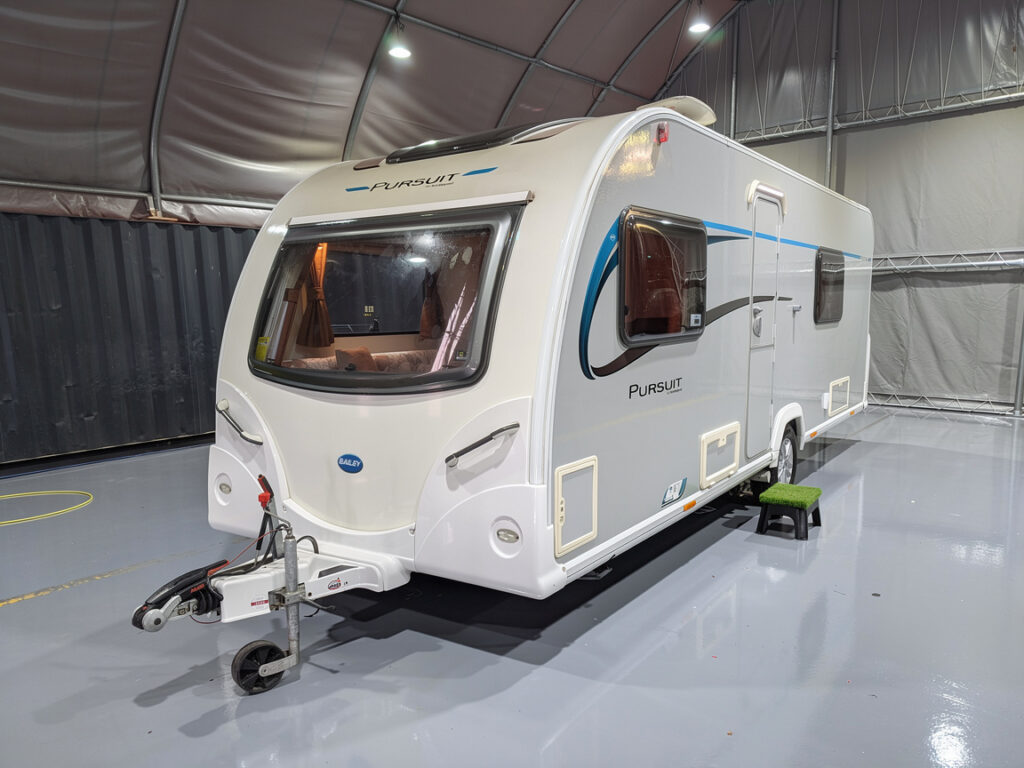
Caravan valeting before sale: what it does and does not do
A valet changes how a caravan looks on the day and in the photographs, and that matters. On a private sale it can be the difference between an enquiry and a scroll past.
What it does not change is anything a proper inspection measures. The damp reading is the same before and after a valet, a soft floor stays soft, and a missing service history stays missing. Independent inspectors know this, and some warn buyers outright that a good valet can hide more than honest grime ever did.
So if you are selling to a dealer, or through one, caravan valeting before sale is rarely money well spent. The caravan is prepared to the dealer’s own standard anyway, and the price is set by the meter and the paperwork. A thorough clean, on the other hand, costs an afternoon and changes how the caravan is judged.
Before you hand your caravan to a dealer
None of this needs a professional, and most of it takes a weekend. It is not a full selling checklist either, just the things that make a dealer’s inspection go your way.
- Empty it. Lockers, bed boxes and the front locker. Leave anything that belongs with the caravan, such as the mover remote, handbooks and spare keys.
- Clean it and drain it. Hoover, wipe down, dry the fridge and leave its door ajar, rinse the toilet cassette, and drain the water system.
- Air it on a dry day. A caravan shut up for months smells damp even when the meter says it is not.
- Charge the leisure battery and test the mover. A flat battery makes everything look broken on inspection.
- Tell the dealer what you already know. Any fault will be found anyway, and saying so up front keeps the valuation straight.
Two things not to do
- Do not patch damp yourself. Fresh sealant round a window with a high reading looks like a cover up to anyone holding a meter, and it costs more in trust than it saves in repairs.
- Do not strip out the extras before you know how they are valued. A fitted motor mover commonly adds £700 to £1,200 to what a caravan can achieve, although not every buyer credits extras the same way. Ask first.
How dealers prepare caravans for sale: common questions
Do dealers check caravans for damp before selling them?
A proper dealer does, with a meter, before anything else happens to the caravan. Readings are taken round the window surrounds, lockers, corners and floor edges. If you are buying, ask to see the readings. If you are selling, expect yours to be checked the same way.
Is it worth valeting my caravan before I sell it?
For a private sale, often yes, because photographs sell caravans. For a dealer sale or sale or return, rarely, because the dealer prepares it to their own standard and the price follows the damp reading and the paperwork rather than the shine. A thorough clean is always worth the afternoon.
Should I get a habitation check done before selling?
Where one is due or overdue, it is usually worth having. A current, documented check answers the first question most buyers ask and lends confidence to everything else. If you are selling through a dealer, ask whether it is done as part of their servicing and preparation before booking your own.
Does the dealer’s preparation come out of my money on sale or return?
It depends entirely on the agreement. Some dealers include preparation in their fee while others bill valeting, servicing or repairs separately. Ask for a written list of what is included before anything is signed, and turn any extra charges into pounds before quotes are compared.
Will a dealer still take my caravan if the inspection finds problems?
Usually, yes. Most faults are either repaired or reflected in the price. Serious damp is the exception that changes the route, because a caravan with active ingress rarely sells well at retail, so an outright sale is often a better answer than sale or return.
Ask us before you start cleaning
Selling soon? Ring us before a weekend is spent on it. We will tell you what is worth doing yourself, and what is better left to preparation.
Talk to us about selling or call 0161 464 0109.
Written by the sales team at Samco Caravans & Motorhomes. We prepare used caravans for sale at our own yard on Bayley Street, Stalybridge, with an engineer on site. More about us.