
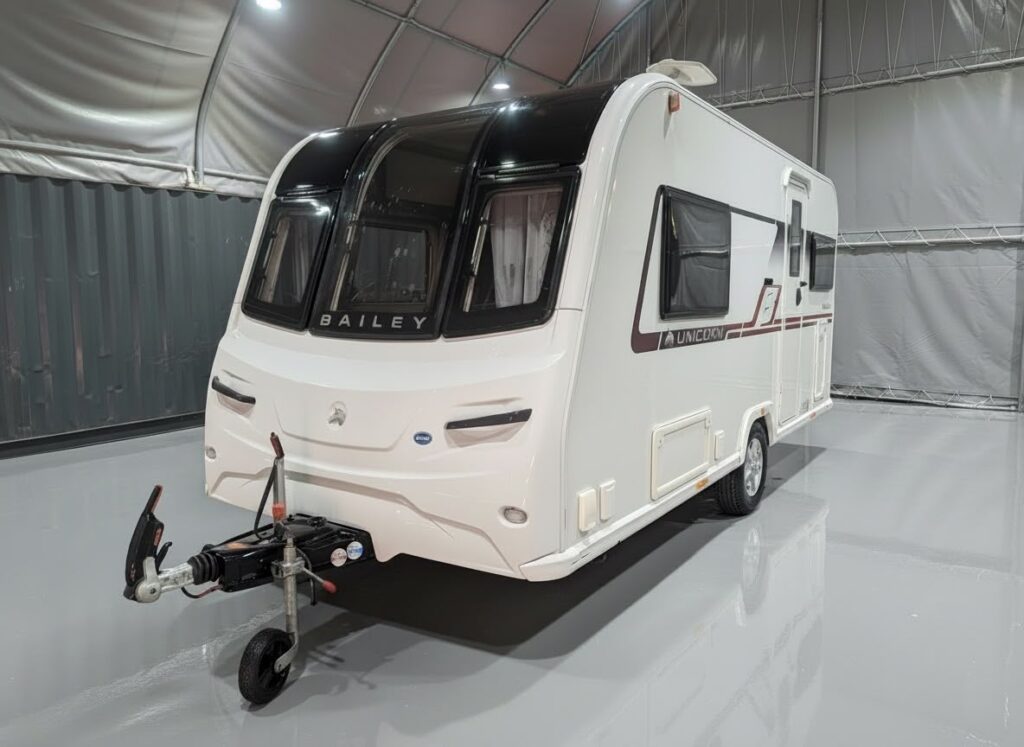
Almost every caravan selling scam ends the same way: the caravan leaves before real money arrives. There are only three shapes to it — a payment that is not real, a buyer who is not real, and bank details that were tampered with on the way to a real buyer. One rule stops all three.
The short version
- The only proof of payment is money showing in your own banking app. Not a screenshot, not an email, not a PDF.
- Never email your bank details. Inboxes get compromised and account numbers get swapped.
- Overpayment followed by “refund the difference” is always a scam. Every time.
- Taking cash? Go to a bank and let a cashier count and check it.
- The keys and the CRIS document do not move until the money is in your account.
Most advice about caravan scams is written for buyers, because buyers are the ones sending money into the dark. Sellers get caught differently, and less is written about it. Selling through a dealer instead removes the problem entirely, but plenty of owners sell privately every year without trouble. This is how they do it.
Fake caravan buyers: the seven scams aimed at sellers
1. The proof of payment that proves nothing
You are shown a screenshot of a completed transfer, a bank statement, or an email confirming the funds are on their way. The caravan goes. The money does not arrive, because it was never sent. Fake bank statements and forged proof of payment are often used to get a caravan released.
How to beat it: open your own banking app and look. If the money is not there and available, nothing else counts — however convincing the paperwork.
2. The overpayment and the refund
You are paid more than the agreed price, apologised to for the mistake, and asked to send the difference back. Their original payment is a cheque that bounces, or a transfer later reversed as fraudulent. Your refund, meanwhile, is real money and gone.
How to beat it: never refund an overpayment. Ask the buyer to have their bank recover it, and carry on as though no payment has been made.
3. The intercepted bank details
This one catches honest buyers and honest sellers at the same time. A seller emails their account details for payment. Somewhere along the line an inbox has been compromised, and the details are quietly edited before the email reaches the buyer. The buyer pays, in good faith, into the fraudster’s account. Nobody realises until the seller asks where the money is.
How to beat it: give your bank details face to face, or read them out over the phone and ask the buyer to read them back. Do not put them in an email, a PDF or a message.
4. The buyer who never comes to see it
An offer arrives before anyone has viewed the caravan, often at full asking price. The buyer is working away, or abroad, or sending a courier to collect. There is always a reason they cannot come themselves.
How to beat it: no viewing, no sale. Anyone spending £10,000 on a used caravan wants to put a hand on it first. Somebody who does not is not buying a caravan.
5. “We have buyers waiting for a caravan like yours”
You are contacted shortly after the advert goes up. They have a list of buyers desperate for your exact model, and finance already arranged. There is a modest fee to put you in front of them, and they would like your card details. The buyers do not exist.
How to beat it: never pay a fee to sell something. Real buyers come to the advert, and real dealers make you an offer rather than charging you for introductions.
6. The message about your advert
You are warned by text or email of suspicious activity on your account, or offered a refund on your listing fee, or asked to confirm a code to verify you are a genuine seller. Each one is a route into your bank account, your email or the advertising account itself.
How to beat it: never follow a link from a message about your own advert, and never read out a verification code to anyone. Go to the website yourself and log in the usual way.
7. The test tow that does not come back
Less common, and far more expensive. A buyer wants to try hitching up, or take it round the block. With the caravan on their towbar and no money paid, you are relying entirely on goodwill.
How to beat it: nothing gets hitched to anyone’s car until the money is in your account. If a buyer wants to check it tows, that is what the handover is for.
If it happens to you: tell your bank the same day, because a payment can sometimes be stopped or recalled while it is fresh. Then report the caravan sale fraud to the national fraud reporting service for England, Wales and Northern Ireland, or to Police Scotland if you are in Scotland. Keep every message, screenshot and bank reference.
How to take payment for a caravan safely
Seven steps, in order. None of the caravan selling scams above survives them, and the whole lot can be done in an afternoon.
- Write a sale note. Two copies, one each: date, make, model, CRIS number, price, and both names and addresses, signed by both of you.
- Hand over your bank details in person or read them out and have them read back. Never by email.
- Have the buyer transfer the money while you are both there. Money is moved in seconds these days, so there is no reason to wait until later.
- Check your own banking app. The money must be showing as available in your balance — not pending, and not on their phone screen.
- If it is cash, go to a bank. A cashier will count it and check the notes. Counting it on your driveway is not the same thing.
- Refuse cheques, PayPal and “escrow” services. A cheque can be cancelled, PayPal is built for posted goods, and caravan advert sites do not hold money for anyone.
- Only then hand over the keys and the CRIS document, and tell CRIS the caravan has changed hands.
Is it safe to sell a caravan privately?
Yes, for most people, most of the time. Thousands of caravans are sold privately every year without incident. But four risks come with it, and they are worth naming plainly.
- Payment fraud. Everything above. It is the big one, and it is the reason to be slow and dull about money.
- Test-tow liability. A stranger towing your caravan on their insurance, on a public road, before they own it.
- Time-wasters. Viewings arranged and not attended, offers made and withdrawn, questions that go nowhere. It costs weekends rather than money.
- Strangers at your home. An advert tells the world you keep a £12,000 asset at your address. Most people are exactly who they say they are. Some are looking rather than buying.
None of that makes private selling wrong. It makes it a job, and one worth doing carefully.
The safe way to sell a caravan, if you would rather not
Selling to a dealer removes all four risks at once. Nobody comes to your house, the money moves between a business account and yours, the paperwork is handled, and any outstanding finance is settled from the proceeds rather than by you.
What you give up is money. A trade offer sits below what a private buyer would pay, and our worked example puts that gap in pounds. If you want the retail price without the strangers, sale or return puts the caravan on a forecourt and the viewings become somebody else’s problem.
Caravan selling scams: common questions
What is the safest way to take payment for a caravan?
A bank transfer made while the buyer is with you, checked in your own banking app before anything is handed over. The money should show as available in your balance, not pending. Cash is fine too, provided it is counted and checked by a bank cashier first.
Can a bank transfer be reversed after it arrives?
Rarely, but it happens. If the money came from a fraud victim’s account, the bank can freeze or recall it while the case is investigated. That is one more reason to sell to somebody you have met, whose name matches the account the payment came from.
Should I take a deposit to hold my caravan?
A small deposit by bank transfer is reasonable once the buyer has viewed the caravan. Be wary of anyone pushing a deposit before they have seen it, or asking you to pay anything to secure the deal. Money should only ever travel towards you.
Is it safe to let a buyer tow my caravan away?
Only after the money is in your account. At that point it is their caravan and their responsibility. Before that, a caravan on a stranger’s towbar is a caravan you may never see again, and their insurance is unlikely to cover a vehicle they do not own.
What should I give the buyer when the caravan is sold?
The CRIS document, both sets of keys, the service history and handbooks, and a signed sale note for each of you. Then notify CRIS that the caravan has changed keeper, so the record follows the caravan rather than staying with you.
Would rather not deal with any of it?
We buy caravans outright and sell them on sale or return, from our own yard in Stalybridge. No adverts, no strangers at your door, and the money comes from a business account.
See the ways to sell or call 0161 464 0109
Written by the sales team at Samco Caravans & Motorhomes
We buy, sell, part exchange and broker touring caravans from our own yard on Bayley Street, Stalybridge — so we hear what happened to the people who tried it alone first. More about us.
Related reading