
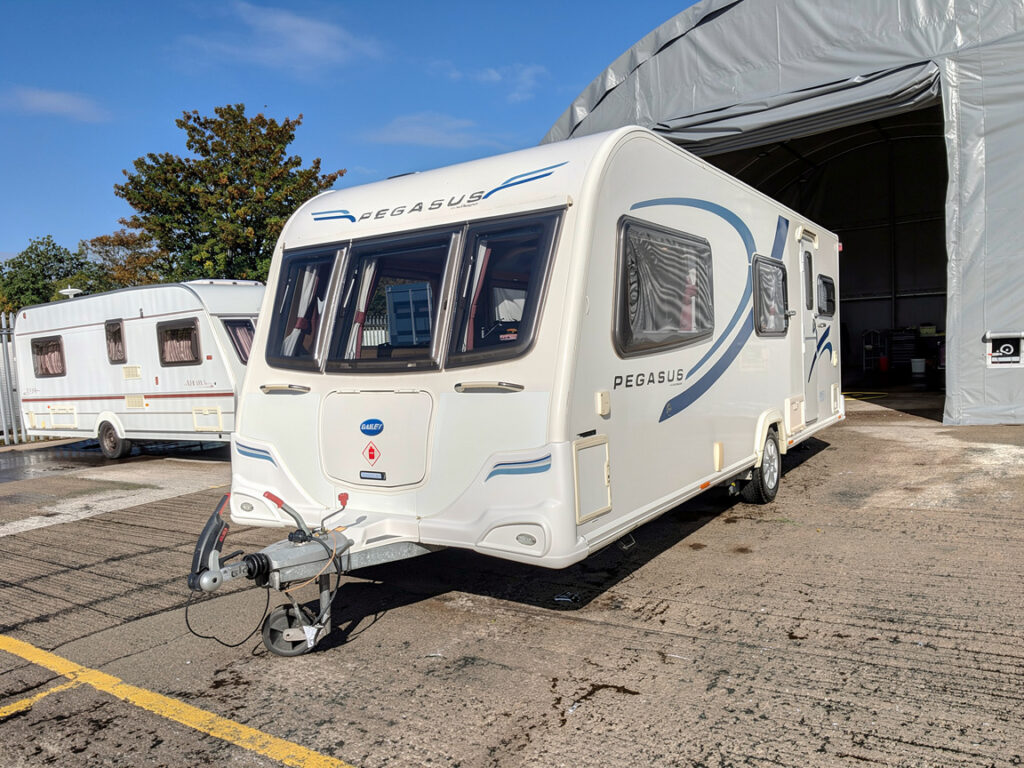
Here is how to sell a caravan in one sentence: find out what it is worth, choose how to sell it, sort out the finance and paperwork, prepare it, and hand it over only once the money is in your account. Then tell CRiS it has changed hands. The route you pick decides how many of those jobs land on you.
The short version
- There is no live trade price guide for caravans any more, so a figure from someone who has inspected yours is worth more than it used to be.
- Choose the route before you prepare anything, because what “ready to sell” means depends on it.
- Ask your lender for a finance settlement figure early. Left until the last minute, it can stall a sale on the day.
- Damp is the biggest single swing factor in the price. Know your readings before a buyer does.
- Payment first, keys last, then tell CRiS. There is no fee.
The steps to sell a caravan are the same whichever way you sell; what changes is who does the work. Sell outright to a dealer and the preparation and viewings largely disappear, while a private sale makes every step yours. If you only want the number for now, start with a free caravan valuation. It gives you a trade figure and a sale or return estimate for the same caravan.
How to sell a caravan: the eight steps at a glance
| Step | What it involves | Still needed if you sell to a dealer? |
|---|---|---|
| 1. Value it | Trade, retail and private figures | Yes |
| 2. Choose a route | Outright, sale or return, part exchange or private | Yes |
| 3. Clear the finance | A settlement figure from your lender | Yes, but a dealer can settle it from the sale |
| 4. Gather the paperwork | CRiS document, service history, both keys | Yes |
| 5. Check its condition | Damp readings, tyres, habitation check | Partly, because the dealer inspects it too |
| 6. Prepare and photograph it | Cleaning, emptying lockers, photos, advert | Mostly no |
| 7. Find a buyer | Adverts, calls, viewings, negotiation | No |
| 8. Get paid and hand over | Payment, keys, notifying CRiS | Yes |
Step 1: Find out what your caravan is really worth
A caravan has three prices, not one. The trade figure is the price paid by a dealer today. The retail price is what the same caravan sells for on a forecourt, prepared and with a dealer behind it. A private sale usually lands somewhere between the two.
Asking prices on listing sites are a useful starting point. However, they are asking prices, not selling prices. There is also no longer a live trade guide to check them against, because caravan pricing data was withdrawn by Glass’s at the start of 2025. That makes a figure from someone who has actually looked at the caravan worth more than it used to be. Our guide to caravan values by year shows how age changes the picture.
Step 2: Choose how you will sell it
There are four main routes, and each one trades money against time and effort.
- Outright sale to a dealer: a trade price, paid on collection, with no viewings.
- Sale or return: it is sold from a dealer’s forecourt at a retail price, and a commission is deducted when it sells. The caravan stays yours until then.
- Part exchange: a trade allowance against the next caravan you buy, judged on what you pay to change rather than the allowance itself.
- Private sale: usually the most money, and all of the work.
Decide this before step five. A caravan going to a dealer needs complete paperwork more than a deep clean, whereas a private sale depends on how it photographs. If the two dealer routes are what you are weighing up, our worked example compares them in pounds.
Step 3: Clear the finance, or know the figure
If the caravan was bought on hire purchase, the finance company owns it until the last payment is made. It cannot be sold privately until that balance is settled, and a buyer’s CRiS check will show the finance anyway. Ask your lender for a settlement figure now, rather than on the day of the sale.
Selling to a dealer makes this simpler, because outstanding finance can be settled directly from the sale and the balance paid to you. Bought it with a personal loan instead? Then the caravan is already yours, and the loan is a separate matter.
Step 4: Gather the paperwork
The same documents are requested by almost every buyer, so find them before the first enquiry comes in.
- The CRiS registration document, which shows the caravan is registered to you
- The service book and habitation check records
- Receipts for work done and extras fitted, such as a motor mover or solar panel
- The owner’s handbooks
- Both sets of keys, plus details of any tracker so the subscription can be transferred or cancelled
A missing CRiS document does not stop a sale, but it slows one down and it worries buyers. Replacements are ordered from CRiS directly. Our paperwork guide covers each document in detail.
Step 5: Know its condition before a buyer does
The same things are checked by every buyer, private or trade. Finding them first means you can price them in, fix them or disclose them.
- Damp. Run a meter round the window surrounds, lockers, corners and roof lights. Readings under 15% are generally accepted, while 20% or more points to active water ingress, and nothing moves the price further.
- Tyres. The Caravan and Motorhome Club recommends replacing caravan tyres at five years old and never using them beyond seven, whatever the tread looks like. Age is counted from manufacture, not fitting, so check the date code on the sidewall.
- Habitation check. A recent one, stamped in the book, answers a buyer’s first question before it is asked.
- Everything that should work. Test the heating, fridge, water pump, lights, hob and motor mover, and note anything that does not.
Found a problem? Price it in or fix it, but do not hide it. A private buyer’s main legal right is that the caravan matches your description, and the fault will be found on a dealer’s inspection anyway. What damp really costs you when you sell puts figures on the most common one.
Step 6: Prepare and photograph it
Presentation matters most on a private sale, where the photos do the selling. Clean it inside and out, empty the lockers and the fridge, and air it for a day so it smells of nothing at all. Personal items are best removed, because buyers want to picture their own holidays, not yours.
Photograph it in daylight: all four corners outside, each area inside, the washroom, a bed made up, and the A-frame and hitch. Autotrader suggests using up to 20 images. Then write the advert, covering the make, model, year, berth, layout, weights, extras, service history and any known faults. Your address should be left out of it.
Step 7: Find a buyer and handle viewings
Timing makes a real difference here. Demand for used tourers climbs from February and holds through the summer, while autumn and winter are noticeably quieter. As a result, a caravan advertised in October will usually take longer to sell privately than the same caravan advertised in February.
When enquiries arrive, screen buyers by phone before they visit. Anyone hoping to sell a touring caravan privately should ask one question early: has the buyer checked your caravan’s MTPLM, its maximum loaded weight, against their towcar? Every viewing should be held with someone else present, and no test tow should be allowed before payment.
Step 8: Get paid, hand over, and tell CRiS
This is the step where caravans are lost to fraud, so do it in this order.
- Write a sale note in two copies, signed by both of you, with the date, make, model, CRiS number, price, and both names and addresses.
- Take payment by bank transfer while the buyer is with you, and check it shows as available in your own banking app. A screenshot on their phone proves nothing.
- If the buyer pays in cash, have it counted and checked by a bank cashier.
- Hand over the keys, the CRiS document, the service history and the handbooks.
- Notify CRiS of the sale using the form on its website. There is no fee.
- Cancel or transfer the insurance, the storage and any tracker subscription.
What changes when you sell to a dealer
Sell outright and the eight steps shrink to three: a figure, a collection date and a payment. With us, you send the details and photos, and an offer is sent back, usually the same day, and held for seven days under our price promise. Collection is free within 150 miles of Stalybridge, and payment is made by bank transfer on collection, before the caravan leaves.
What you give up is the gap between trade and retail. On a newer caravan in a popular layout, that gap can be worth chasing. On an older one, or one with damp, it is often too small to justify months of viewings.
How to sell a caravan: common questions
How can I sell my caravan quickly?
Sell it outright to a dealer. A dealer buying for their own stock can usually make an offer within a day. Payment is then made by bank transfer on collection, so a sale can be completed within days of the first enquiry. A private sale or sale or return can get more money, but both depend on finding a buyer, which takes longer.
How do I find out how much my caravan is worth?
Get a valuation from someone who inspects it. Listing sites show asking prices rather than selling prices, and there has been no live trade price guide for caravans since Glass’s withdrew its data in 2025. An inspection-based figure accounts for damp readings, layout and service history, which move the price more than age alone.
What is the 10 year rule for caravans?
It is a planning rule, and it has nothing to do with selling a touring caravan. It concerns static caravans lived in as a home without planning permission, which can become immune from enforcement after ten years of continuous use. A touring caravan can be sold at any age.
Can I sell a caravan with finance still owing?
Yes, but the finance has to be settled as part of the sale. On hire purchase, the finance company owns the caravan until the final payment is made. Ask your lender for a settlement figure; a dealer can usually pay it directly from the sale price and pass the balance on to you.
What if I have lost the CRiS document?
You can still sell the caravan, but replace the document first if you can, because replacements are ordered from CRiS directly. Without one, private buyers are warier and dealers may offer less, since the buyer is carrying the risk of an unproven history.
Ready to start with step one?
Tell us the make, model, year and layout, add a few photos, and we will come back with a figure, usually the same day. Nothing is committed until you say yes.
See the ways to sell your caravan or call 0161 464 0109
Written by the sales team at Samco Caravans & Motorhomes
We value, buy and sell touring caravans at our yard on Bayley Street, Stalybridge. Every step above is one we go through ourselves on the caravans we take in. More about us.
Related reading