
Sale or return usually pays more than an outright sale, but not always, and never as quickly. It is worth it when the gap between the retail price and the trade offer is bigger than the commission plus the cost of waiting. If the outright offer comes within a few hundred pounds of what you would net, take it.
The short version
- Sale or return aims at a retail price. An outright sale pays trade money, on collection.
- Commission is taken from whatever the caravan finally sells for, not from the asking price first agreed.
- A flat fee is expensive on a cheap caravan and cheap on an expensive one.
- The cost of waiting is rarely counted: insurance, storage, finance interest and a missed season.
- The aim is simple. Find the outright offer that beats your sale or return figure.
Most advice on sale or return vs outright sale stops at “you get more, but it takes longer”. That is true, however it decides nothing. What is needed is your own number, meaning the outright offer at which waiting stops being worth it. The method is set out below and worked through on a real caravan from our own forecourt.
Already sure you would rather sell this way? See how our sale or return service works and skip the maths. Otherwise, your number is worked out in four steps further down.
Is sale or return worth it?
Sale or return is worth it when the caravan is in good retail condition, no fixed deadline has been set, and the retail price minus the fee beats the outright offer by more than the wait will cost you. For older, damp or low value caravans, the outright offer usually wins.
| Sale or return usually wins when | An outright sale usually wins when |
|---|---|
| The caravan is dry, serviced and a popular layout | The damp meter says otherwise |
| No deadline has been set for the money | The money is needed by a set date |
| The retail price sits well above the trade offer | The caravan is worth so little that any fee eats the gap |
| The caravan can be placed before the new year | It is October and a quick, clean sale is wanted |
Worked through on a 2016 Swift S-Line 630
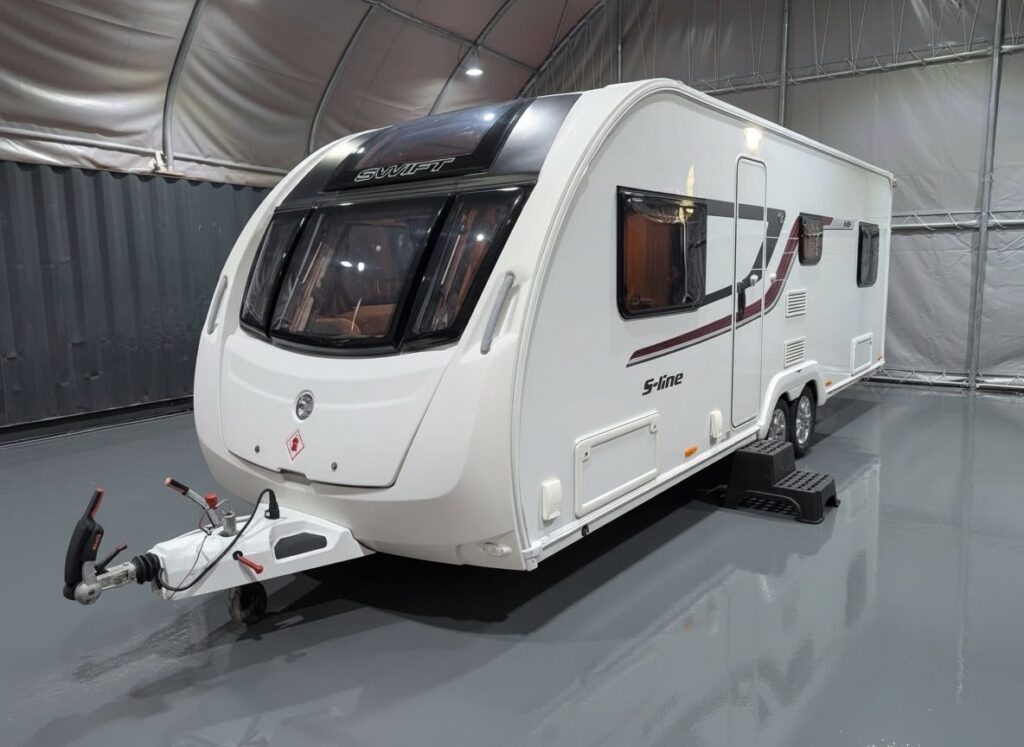
Take a caravan on our forecourt today, a 2016 Swift S-Line 630, six berth, with an end bedroom and washroom, listed at £12,995. Suppose yours is a close match and sale or return is offered at that same asking price. Four steps are all that is needed.
- Start with the price the caravan will actually be advertised at. Here, that is £12,995.
- Take off a realistic allowance for negotiation, because buyers haggle and very little sells at the sticker.
- Take off the commission or fee that has been agreed, exactly as it is written in the agreement.
- Whatever is left is your number to beat.
That final figure, rather than the asking price, is what should be held against the outright offer. Any outright offer above it pays more, sooner, and with no risk at all, before a single week of waiting has even been counted.
One more line is worth checking. Where VAT is added on top of the fee rather than included within it, the deduction grows and your number falls, even though the headline rate has not changed. Always ask whether the fee quoted includes VAT or has it added on top.
Why the rate matters more than it looks
Commission is charged as a share of the final sale price, so the same rate behaves very differently from one vehicle to the next. On a £6,995 2011 Lunar Lexon 530, a single percentage point is small money. On a £23,995 2018 Vauxhall Vivaro campervan, the same percentage point is not. Consequently, a rate that sounds reasonable on a cheap caravan can become the largest single deduction on a dearer one.
Whatever rate is quoted, ask for it to be shown in pounds against your own asking price. A figure in pounds is far harder to misread than a percentage, and it is the only form in which two quotes can be compared honestly.
Fixed fee or percentage?
Some brokerage is charged as a flat fee instead of a percentage. Neither is automatically cheaper, because it depends entirely on what the caravan is worth. A flat fee is a large share of a cheap caravan and a small share of a dear one, so a percentage tends to suit cheaper caravans while a flat fee tends to suit dearer ones.
Any fee should therefore be converted into a percentage of your own asking price before two quotes are compared. There is also a third model, where a fixed net figure is guaranteed to you and any surplus is kept by the dealer. That one works differently again, and the difference between the commission and net figure models is worth understanding before anything is signed.
What the wait costs you
Every comparison of sale or return vs outright sale leaves out the same thing. An outright offer is paid on collection. Sale or return pays when a buyer turns up, and that could be in a few weeks or on the far side of winter.
- Insurance normally stays in your name until the caravan sells, so the premium keeps running.
- Storage may keep running too, depending on whether your pitch is held while the caravan is away.
- Finance interest keeps accruing on any outstanding finance agreement until it is settled from the sale.
- The season matters. Buyers look hardest from January to March, so a caravan that misses that window can sit, and may need repricing to move.
None of these is large on its own. Added together over a slow autumn, however, the gap you were waiting for can be quietly erased. That is why the timing of the decision matters almost as much as the decision itself.
How to compare your two quotes, step by step
Ten minutes, two quotes and a calculator will settle sale or return vs outright sale for your own caravan. This is the whole method.
- Get the outright offer in writing, including the figure, the collection date and the day the money lands in your account.
- Get the sale or return asking price in writing. A forecourt price is wanted here, not a hopeful range.
- Find out how the dealer is paid, whether by a percentage, a fixed fee or a guaranteed net figure, and whether VAT is added.
- List everything else that comes off, such as preparation, valeting, a service or a warranty for the buyer. Some are included in the fee while others are billed separately.
- Allow for negotiation by knocking a realistic amount off the asking price, because buyers haggle.
- Add up what waiting costs you in insurance, storage and finance interest, then ask honestly whether the January rush would be missed.
- Compare the two. Where sale or return beats the outright offer by less than the wait and the risk are worth to you, the outright offer should be taken.
Sale or return vs outright sale: common questions
Does sale or return always pay more than an outright sale?
No. It pays more when the gap between retail and trade is bigger than the fee plus the cost of waiting. On older, damp or low value caravans that gap is often too small to bother with. A sale is never guaranteed either, whereas an outright offer is money on collection.
How big is the gap between a trade offer and the retail price?
It varies with the caravan, the season and what the dealer already has in stock. The gap exists because preparation, warranty and the risk of the caravan sitting are all carried by the dealer. The quickest way to see it is to ask one dealer for both figures on the same caravan.
Is a fixed fee better than a percentage commission?
It depends entirely on the value of the caravan. A flat fee takes a far larger share of a cheap caravan than of an expensive campervan, so a percentage tends to suit cheaper caravans and a flat fee tends to suit dearer ones. Whichever is quoted, convert it into a percentage of your asking price before the quotes are compared.
What does it cost me if my caravan does not sell?
Mostly time. The insurance will have been carried by you, possibly storage and any finance interest for the months it was on display, and a slower season may be approaching. Ask any dealer, before signing, whether anything is charged if the caravan comes back unsold.
When is the best time of year to sell on sale or return?
Before the new year. Buyers look hardest from January to March, ahead of the touring season, so a caravan that is placed and priced by then is given the longest run at retail. One placed in October can sit through the quiet months before the right buyer appears.
Get both numbers from one dealer
Sale or return vs outright sale is decided far more easily when both numbers come from the same yard. Ask us for an outright offer and a sale or return asking price on the same caravan. Then do the sum above and choose with the figures in front of you.
Ask for both figures or call 0161 464 0109.
Written by the sales team at Samco Caravans & Motorhomes. We buy caravans outright and sell them on sale or return from the same yard on Bayley Street, Stalybridge, so both sides of this sum are seen here every week. More about us.